
Imagine you’re merging onto I-225 during a busy morning rush when you feel an unsettling vibration in your steering wheel. It’s more than just a nuisance; it’s a clear signal that your Mazda’s precision-engineered braking system is struggling with Colorado’s demanding driving conditions. Finding reliable Mazda brake repair Aurora drivers can trust means looking beyond a generic fix to understand the specific needs of your SkyActiv vehicle. Whether it’s a persistent squeal or a loss of responsiveness, these signs require a methodical approach to ensure your safety on the road.
We understand the stress that comes with unexpected car trouble and the common fear of being overcharged for complex repairs at a dealership. You deserve a partner who prioritizes your vehicle’s longevity and provides clear, honest communication throughout the process. This article will show you why specialized service is essential for maintaining your Mazda’s signature performance and safety. We’ll examine the technical details of components like the i-ELOOP regenerative braking system and explain how an expert diagnosis leads to restored stopping power and transparent pricing you can rely on.
Key Takeaways
- Identify early warning signs like high-pitched squealing or steering wheel vibrations before they lead to expensive repairs or compromised safety.
- Discover why professional Mazda brake repair Aurora involves more than just a pad swap, requiring specific diagnostic tools to handle SkyActiv-Vehicle Dynamics safely.
- Understand the “Mountain Effect” and how Colorado’s unique road salts can accelerate brake fade and corrode your Mazda’s calipers.
- Learn the technical differences between OEM and aftermarket components to maintain your vehicle’s signature “Jinba Ittai” handling and responsiveness.
- Find out how a transparent, expert-led diagnostic process provides a reliable and cost-effective alternative to traditional dealership service.
Common Signs Your Mazda Needs Brake Service in Aurora
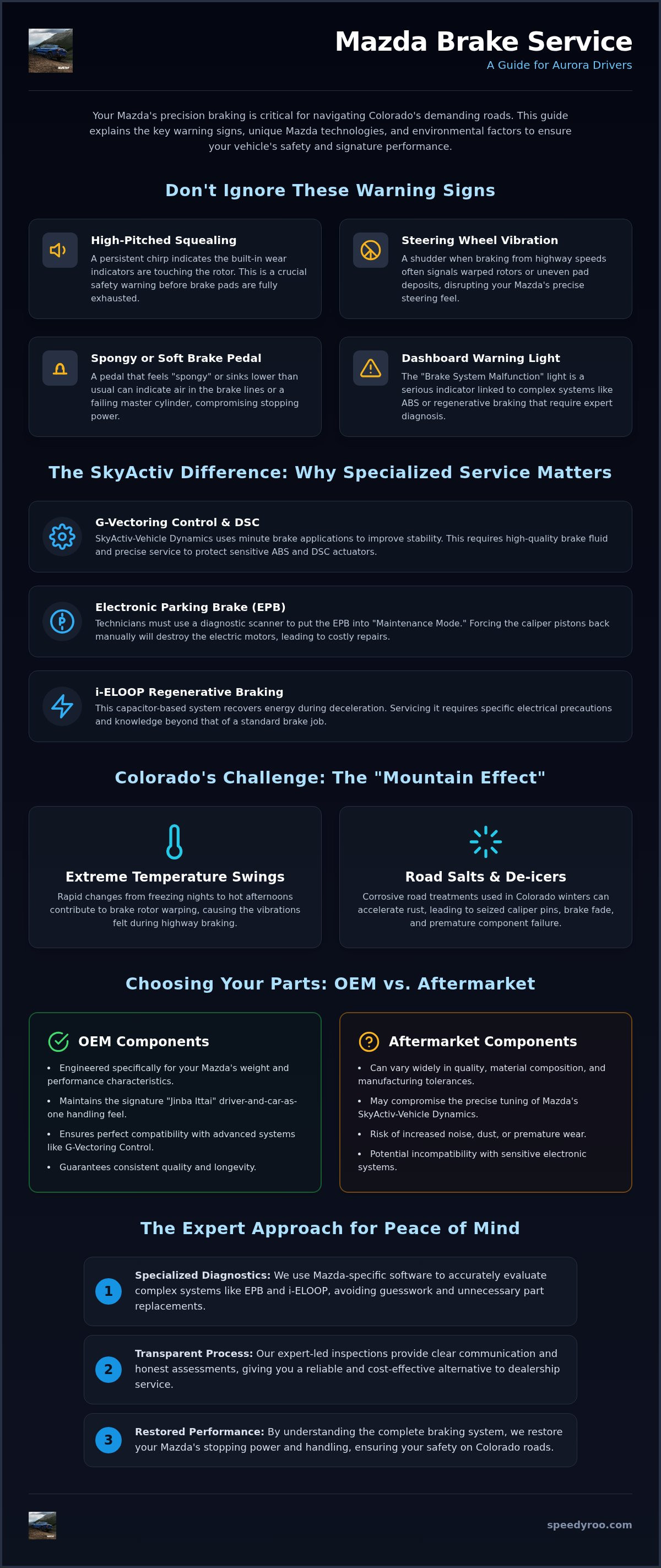
Driving in Aurora means dealing with varied terrain and heavy traffic on I-225. Your Mazda is designed for high-level performance, but that responsiveness depends entirely on a healthy braking system. If you’ve noticed a change in how your car stops, it’s time to consider a professional Mazda brake repair Aurora specialist. Ignoring small signs can lead to larger, more expensive repairs that compromise your safety. Look for these specific indicators that your vehicle needs an expert inspection:
- High-pitched squealing: A persistent “chirp” while driving or braking.
- Steering wheel vibration: A noticeable shudder when slowing down from highway speeds.
- Soft brake pedal: A “spongy” feel that requires more foot pressure than usual.
- Dashboard warnings: The “Brake System Malfunction” light appearing on your SkyActiv display.
Audible Warning Signs
Morning surface rust is common in Colorado’s humidity, often creating a brief scraping sound that disappears after a few stops. However, a persistent high-pitched chirp usually indicates that the mechanical wear indicator on your Mazda OEM pads is making contact with the rotor. This is a built-in safety feature designed to warn you before the pad material is completely gone. If you hear a heavy metal-on-metal grinding, the pads are likely exhausted. This puts your rotors at immediate risk of damage and significantly increases your stopping distance.
Physical Feedback and Vibrations
Colorado’s extreme temperature swings, from freezing nights to hot afternoon commutes, can contribute to rotor warping. When you brake from highway speeds and feel a shudder in the steering wheel or a pulsation in the pedal, it’s often a sign of uneven pad deposits or warped rotors. Because Mazda vehicles are tuned for precise steering, even minor brake hardware issues can disrupt the connection between driver and car. In older models, it’s also vital to distinguish these vibrations from worn suspension bushings. An expert diagnosis ensures you aren’t replacing parts unnecessarily while restoring your Mazda brake repair Aurora standards.
A “spongy” pedal that sinks lower than usual often points to air in the lines or a failing master cylinder. On modern SkyActiv models, the “Brake System Malfunction” light is a serious indicator. This light often links to complex components like the regenerative braking system (i-ELOOP), which requires specialized diagnostic software to evaluate correctly. Addressing these signs early keeps your Mazda performing as the engineers intended.
Mazda-Specific Brake Technology: Beyond Standard Pads
Mazda’s engineering philosophy, known as SkyActiv, treats the vehicle as a single integrated unit. This means your brakes do more than just stop the car; they are active participants in SkyActiv-Vehicle Dynamics. For example, G-Vectoring Control uses minute brake applications to shift weight during cornering, which improves stability and steering feel. Because these systems are so precise, using the correct high-quality brake fluid is vital to protect the delicate ABS and Dynamic Stability Control (DSC) actuators from internal corrosion. A standard service at a generic shop might overlook these technical requirements, but specialized Mazda brake repair Aurora services ensure these integrated systems remain in peak condition.
Servicing the Electronic Parking Brake (EPB)
Many modern Mazdas feature an Electronic Parking Brake (EPB) instead of a traditional cable-and-lever system. Attempting a DIY pad change or visiting a shop unfamiliar with this technology can be a costly mistake. If a technician tries to force the rear caliper pistons back manually without engaging the vehicle’s “Maintenance Mode,” they can easily destroy the electric motors, leading to thousands in avoidable damage. We use specialized diagnostic scanners to electronically retract these motors, ensuring a safe and precise pad replacement. EPB service is a standard part of our Mazda brake repair in 2026.
I-ELOOP and Regenerative Braking
Higher trim levels of models like the Mazda6 and CX-9 often feature i-ELOOP, a unique form of kinetic energy recovery. Unlike most hybrids that use heavy batteries, i-ELOOP utilizes a high-capacity capacitor to store energy captured during deceleration. This energy then powers the car’s electrical systems, reducing the load on the engine. These advanced safety systems and efficiency technologies require specific precautions during service. Working on the alternator-based i-ELOOP system involves specific electrical components that demand specialized knowledge to avoid electrical faults or system resets during a brake job.
When you seek out Mazda brake repair Aurora, you’re looking for someone who understands these intricate nuances. If you’re unsure about the health of your SkyActiv system or the status of your regenerative braking capacitors, a professional Mazda repair and service consultation can provide the clarity you need to stay safe on the road. Our methodical approach ensures that every component, from the pads to the electronic actuators, functions exactly as the factory intended.
How Colorado Driving Conditions Affect Your Mazda’s Brakes
Driving a Mazda in the Denver metro area offers a unique set of challenges that standard maintenance schedules often fail to account for. Between the high-altitude environment and the aggressive chemicals used on Aurora roads, your braking system faces constant environmental stress. Professional Mazda brake repair Aurora services must account for these local factors to ensure your vehicle remains reliable year-round. From the thin air of the Mile High City to the steep grades of the Rockies, your car’s stopping power is tested every day.
At 5,280 feet and above, the boiling point of brake fluid can be affected by changes in atmospheric pressure and moisture. In our local climate, moisture contamination in your brake fluid is dangerous because it can lead to “pedal fade” during heavy use. This is particularly critical when your car’s NHTSA explains advanced driver-assistance technologies like Automatic Emergency Braking (AEB) are active. These systems rely on immediate, consistent hydraulic pressure to function correctly and prevent collisions.
Managing Brake Heat on Steep Descents
If you frequently drive I-70 into the mountains, you’ve likely experienced the smell of hot brakes. Long, steep descents can lead to “glazing,” a condition where the brake pads become overheated and develop a smooth, glass-like surface. This significantly reduces the friction needed to stop the car effectively. To prevent this, we recommend using your Mazda’s paddle shifters or manual gear mode to utilize engine braking. Our team also provides expert Subaru Repair in Aurora, giving us deep experience with how different all-wheel-drive systems handle mountain stress and heat dissipation.
Combating Corrosion and Road Chemicals
While the mountains bring heat, Aurora winters bring Magnesium Chloride. This liquid de-icer is effective at melting ice, but it’s also a silent killer for brake calipers. It seeps into the rubber boots and causes caliper slide pins to seize, which leads to uneven pad wear and reduced fuel economy. To combat this, we perform a meticulous cleaning and lubrication of these pins during every Mazda brake repair Aurora visit. We also prefer using replacement rotors with high-quality anti-corrosive coatings. These coatings prevent the “rust lip” that often develops on the outer edge of the rotor, ensuring your brakes remain quiet and effective even after a harsh Colorado winter.
Mazda’s i-ACTIV AWD system is designed to provide proactive grip, but it also means your brakes work harder to manage traction and stability. Balanced brake wear is essential for the longevity of your drivetrain, making seasonal inspections a vital part of your vehicle’s health. Catching a sticking caliper early can save you from replacing an entire set of rotors prematurely.
Choosing the Right Brake Components for Your Mazda
Selecting the right parts for your vehicle is about more than just finding what fits; it’s about preserving the ‘Jinba Ittai’ connection between you and the road. When you schedule a Mazda brake repair Aurora service, the components chosen will determine whether your car maintains its factory-tuned responsiveness or feels unpredictable. We prioritize parts that balance long-term durability with the specific performance characteristics Mazda engineers intended for your model. Using the wrong components can disrupt the balance of your SkyActiv system, leading to a firmer or softer pedal feel than you expect.
Pad Material Comparison
For many Aurora drivers, ceramic pads are the preferred choice for daily commutes. They operate quietly and produce significantly less dust, which helps keep your wheels cleaner over time. However, semi-metallic pads are often superior for those who frequently drive in the mountains. Their ability to dissipate heat quickly makes them more resilient against the glazing that can occur on steep descents. Once installed, it’s vital to properly ‘bed in’ your new pads. This process involves a specific series of controlled stops that transfers a consistent layer of friction material to the rotor, preventing uneven wear and annoying brake squeal.
Rotor Quality and Performance
While slotted or drilled rotors offer a performance aesthetic, they aren’t always necessary for a Mazda3 or CX-5 daily driver. We generally prioritize rotors with a high carbon content because they offer better thermal stability and are less prone to warping during Colorado’s temperature swings. During a professional Mazda brake repair Aurora inspection, we’ll measure your current rotors to see if they can be resurfaced. Resurfacing is a cost-effective way to restore a smooth braking surface, but if the metal has worn past the manufacturer’s minimum thickness, a full replacement is the only safe path forward to prevent cracking or failure.
If you drive an MX-5 Miata or one of the turbocharged CX models, you might consider high-performance hardware upgrades. These components are designed to handle the higher stresses of spirited driving without compromising the precise pedal feel Mazda is known for. For broader maintenance advice and to learn about common vehicle myths, you can read more about Japanese Import Repair in Aurora. To ensure your vehicle remains safe and responsive, contact us today for a comprehensive Mazda repair and service consultation where we can diagnose your specific needs.
Expert Mazda Brake Repair at Speedy Roo Motorsports
Finding a shop that understands the delicate balance of a Mazda’s chassis requires more than just a general mechanic. At Speedy Roo Motorsports & Repair Inc, we provide the specialized Mazda brake repair Aurora drivers need to maintain their vehicle’s precision. Our facility is equipped with the specific diagnostic software required to communicate with SkyActiv-Vehicle Dynamics and safely manage Electronic Parking Brake (EPB) systems. We don’t just swap parts; we ensure every electronic and hydraulic component is calibrated to maintain that signature Mazda steering feel.
Our shop is conveniently located in Aurora, making us a central hub for owners in Denver, Centennial, and Parker. We’ve built our reputation on a “no-surprises” approach. This means every inspection results in a clear, itemized quote and an explanation of which repairs are urgent for safety and which can be planned for the future. You’ll never feel pressured into unnecessary services because we value long-term trust over a single transaction.
The Speedy Roo Difference
We’ve served as the “Expert Neighbor” for the local community since 2002, specializing in the unique needs of Japanese imports. Our technicians prioritize premium parts that meet or exceed factory standards, ensuring your stopping power is never compromised by inferior materials. Beyond standard maintenance, our Pre-Sale Vehicle Evaluation is a vital resource for those looking to buy a used Mazda, helping you identify hidden brake wear or seized calipers before you finalize a purchase. This commitment to thoroughness is why Speedy Roo Motorsports & Repair Inc remains a preferred alternative to high-priced dealerships.
Schedule Your Mazda Brake Inspection
Getting your brakes checked shouldn’t be a stressful experience. When you visit our Aurora shop, our service advisors will walk you through the diagnostic findings and show you exactly what our technicians see. Whether you need a simple pad replacement or a complex repair of your i-ELOOP regenerative system, we handle the task with methodical care. We offer easy online booking and phone consultations to fit your busy schedule. Don’t wait for a small squeal to become a major safety risk. Schedule your Mazda brake repair in Aurora today and experience the difference that specialized expertise makes for your vehicle’s longevity.
Restore Your Mazda’s Signature Driving Dynamics
Maintaining the precise handling and stopping power of your SkyActiv system requires more than just standard maintenance. As we’ve discussed, Colorado’s unique environment demands a proactive approach to prevent glazing on mountain descents and corrosion from winter road chemicals. By choosing specialized Mazda brake repair Aurora services, you ensure that complex components like the Electronic Parking Brake and i-ELOOP system are handled with technical precision. Using the correct pad materials and high-carbon rotors isn’t just about safety; it’s about preserving the responsive “feel” that makes driving a Mazda special.
Since 2002, Speedy Roo Motorsports & Repair Inc has served as an independent alternative to expensive dealerships, providing the community with dealership-level diagnostics and a 5-star reputation for honesty. We’re committed to being your partner in long-term vehicle health, offering transparent inspections that put you in control of your repairs. Don’t let a small vibration or squeal compromise your safety on I-225 or high-altitude mountain passes. Book Your Mazda Brake Inspection at Speedy Roo Motorsports & Repair Inc today. We look forward to helping you get back on the road with total confidence in your vehicle’s stopping power.
Frequently Asked Questions
How much does Mazda brake repair cost in Aurora?
Costs for Mazda brake repair Aurora depend on the specific model and which components require attention, such as pads, rotors, or calipers. Factors like the inclusion of i-ELOOP regenerative technology or Electronic Parking Brakes also influence the final estimate. We provide a transparent, itemized quote before any work begins to ensure clarity and honesty. This approach aligns with the Colorado Motor Vehicle Repair Act, which requires written estimates for all automotive repairs.
How often should I have my Mazda’s brakes inspected in Colorado?
We recommend a professional brake inspection at least every six months or every 10,000 miles. Colorado’s harsh driving environment, including steep mountain descents and corrosive road salts, can accelerate wear on your pads and rotors. Regular checks allow us to catch seizing caliper pins or thinning pads early. This proactive maintenance helps local drivers avoid more expensive repairs and ensures your SkyActiv safety systems function as intended during unpredictable winter weather.
Can I change my own Mazda brakes if I have an electronic parking brake?
It’s not recommended to perform a DIY brake change on Mazdas equipped with an Electronic Parking Brake (EPB) without specialized equipment. These systems require a specific “Maintenance Mode” to electronically retract the rear caliper motors. Forcing the pistons back manually can cause significant and costly damage to the electronic actuators. Our specialists use dedicated diagnostic tools to safely service these advanced systems, ensuring your parking brake remains fully operational and correctly calibrated.
Why do my Mazda brakes squeak only in the morning?
Morning brake squeak is usually caused by a thin layer of surface rust that forms on the rotors overnight due to humidity or rain. This is a common occurrence in the Aurora area and typically disappears after the first few stops as the pads scrub the rotors clean. However, if the noise persists throughout your commute or turns into a grinding sound, it indicates that your pads have reached their wear limits and require immediate professional attention.
What is the difference between Mazda OEM and aftermarket brake pads?
Original Equipment Manufacturer (OEM) pads are designed by Mazda to match the exact performance and noise specifications of your vehicle. They ensure the intended “Jinba Ittai” driving feel. High-quality aftermarket pads can offer specialized benefits, such as better heat dissipation for mountain driving or lower dust for city commutes. We help you choose the right components based on your specific driving habits, ensuring every part meets the rigorous standards required for your SkyActiv chassis.
Does Mazda brake repair require special software?
Yes, modern Mazda vehicles require specialized diagnostic software to properly service the braking system. This software is essential for communicating with the SkyActiv-Vehicle Dynamics modules and for setting the Electronic Parking Brake into service mode. It also allows technicians to perform necessary system resets after a fluid flush or component replacement. Without these tools, a shop cannot fully verify that your advanced safety features, like Automatic Emergency Braking, are calibrated and functioning correctly.
How long does a typical brake pad and rotor replacement take at Speedy Roo Motorsports & Repair Inc?
A standard pad and rotor replacement for a single axle at Speedy Roo Motorsports & Repair Inc typically takes 60 to 90 minutes. This timeframe includes a comprehensive inspection of the calipers and a cleaning of the hub surfaces to ensure a perfect fit. While the mechanical work is efficient, we take the time to test the system and verify all electronic components. Our methodical approach to Mazda brake repair Aurora ensures your vehicle is safe for the road.
Will upgrading my brakes affect my Mazda’s warranty?
Upgrading your brakes with high-quality components generally does not void your vehicle’s manufacturer warranty. Under the Magnuson-Moss Warranty Act, a dealer cannot deny a warranty claim simply because an aftermarket part was used, unless they can prove the part caused the specific failure. We use premium parts that meet or exceed factory specifications to maintain your vehicle’s integrity. If you have concerns about specific performance upgrades, our team can provide guidance on maintaining your warranty coverage.