
A reliable mechanic in Lone Tree should explain what diagnostics show and get your approval before performing work outside the original estimate or exceeding it by more than 10%, as the U.S. Environmental Protection Agency advises. Ask whether the shop is trained to work on OBDII-equipped vehicles, too.
A high rating can be a useful starting point, but it doesn’t tell you everything about a shop’s experience, repair process, or warranty terms. It’s reasonable to expect clear recommendations, evidence behind a diagnosis, and a straightforward explanation before approving work.
This guide looks at how to assess local mechanic experience, common repairs, and verified customer reviews, then compare certifications, diagnostics, and warranty details. You’ll also learn what to ask before approving a repair and how to tell whether a shop’s strengths match your vehicle’s needs.
Key Takeaways
- Read customer reviews for details about communication, repair outcomes, and follow-through, not just the overall rating.
- Learn how technician credentials and diagnostic tools can help identify the cause of a problem before repairs begin.
- Compare mechanics’ experience with your vehicle’s make and the type of repair it needs.
- Review what a warranty covers, how long coverage lasts, and which conditions or exclusions apply.
- See when Subaru Repair and Service at Speedy Roo Motorsports & Repair Inc may fit your vehicle’s needs.
Shop ratings and verified customer reviews
A star rating gives a quick impression, but a useful review explains what happened during a specific visit. In Lone Tree, Colorado, customer reports describe spark plug service performed by Hugh and a pre-purchase inspection performed by Gregory. Those named examples offer more context than a rating alone, though they don’t establish how every shop handles every repair.
Read several recent reviews and look for details tied to the work you need. A review about diagnostics may show how clearly a technician explained a fault, while a comment about routine maintenance may reveal more about scheduling and communication. Match the reviewer’s vehicle or repair type to your situation when possible. This helps you judge whether the feedback applies to your repair needs.
Customer testimonials are most useful when they describe a sequence: what problem brought the vehicle in, what the shop found, how it explained the recommendation, and whether the repair addressed the concern. Compare positive and critical accounts for specific patterns. Repeated mentions of unclear updates deserve attention; a single vague complaint offers less practical information. Treat a detailed account as evidence of one customer’s experience, not a promise about your outcome.
Use this quick review-reading process:
- Check whether the reviewer names a repair, vehicle, or service visit.
- Look for explanations of diagnosis, authorization, and follow-up.
- Compare feedback across more than one review platform.
- Separate firsthand details from broad praise or criticism.
Verified status can help distinguish a documented customer experience from an anonymous claim, but it doesn’t replace reading the review itself. A report that identifies the service and the person who performed it is easier to assess than a one-line rating. Look for consistency across accounts, not identical wording or perfect scores.
Customer amenities also affect a repair visit, especially when you’ll wait while work is underway. Reviews may mention a waiting area, clear arrival instructions, or transportation assistance. Treat these as practical details, not proof of repair quality. If you need to stay nearby, note which amenities reviewers describe and how those details affected their visit.
Finally, search reviews using the repair type and the phrase “help me” only as a way to find customer accounts describing a similar concern. A reliable mechanic in Lone Tree should be assessed through specific evidence: relevant repair experience, clear explanations, and consistent follow-through. Reviews can narrow your options; the shop’s direct explanation of its diagnosis and proposed work helps you make the next decision.
ASE-certified technicians and diagnostic equipment
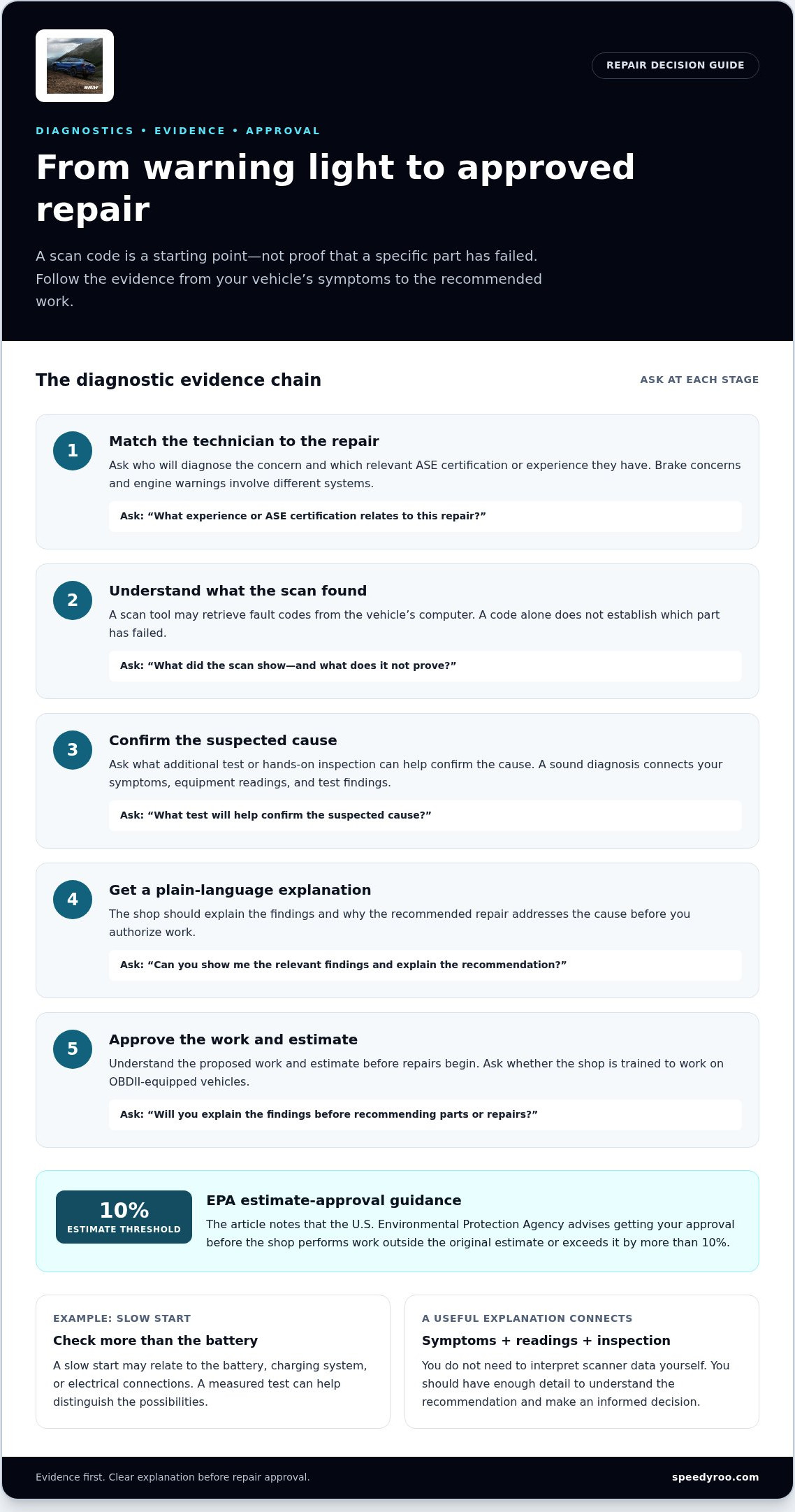
An ASE credential can tell you about a technician’s training, but it isn’t a diagnosis. Ask which technician will work on your vehicle and whether their experience relates to the repair. Brake concerns and engine warnings, for example, involve different systems. A clear answer helps you connect the technician’s background to the problem you need solved.
Diagnostic equipment is useful when it guides a technician’s next test. A scan tool may retrieve fault codes from a vehicle’s computer, but a code alone doesn’t prove which part has failed. If a dashboard light appears, ask what the code indicates, what additional checks are needed, and how the results support the recommended repair. This helps distinguish diagnosis from simply replacing a suspected part.
The U.S. Environmental Protection Agency advises asking whether a repair shop is trained to work on OBDII-equipped vehicles. OBDII is the vehicle diagnostics system used to report certain faults. Training matters because interpreting a code involves more than reading a scanner display. A technician needs to relate the code to the vehicle’s symptoms and test findings.
Use these questions to understand the process:
- Which technician will diagnose the concern, and what relevant ASE certification do they hold?
- What did the diagnostic scan show, and what does it not establish?
- What test will help confirm the suspected cause?
- Will you explain the findings before recommending parts or repairs?
A weak battery is a useful example. A slow start may relate to the battery, charging system, or electrical connections. A measured test can help distinguish those possibilities. Ask the technician to explain the result and how it supports the proposed next step. The same approach applies to warning lights: symptoms, scan data, and follow-up testing should form a coherent explanation.
Also consider how the auto repair shop communicates technical information. A friendly service advisor should be able to describe the fault in plain language, show relevant findings, and explain why a repair addresses the cause. You don’t need to interpret scanner data yourself. You do need enough detail to understand the recommendation and make an informed decision.
Good diagnostics connect a customer’s description, equipment readings, and hands-on inspection. Before authorizing work, summarize the symptom in your own words and ask the technician to explain the evidence. For brand-specific maintenance and repairs, explore Japanese vehicle repair and service as a relevant option for supported makes.
Ask which technician will work on your vehicle and what experience or ASE certification relates to the repair. Have them explain how that background fits the problem you need solved.
Local mechanic profiles and experience
A mechanic’s profile is more useful when it shows what vehicles and problems they handle. In Lone Tree and nearby communities, match the shop’s stated experience to your vehicle’s make, model, and symptoms. A profile focused on routine maintenance may not tell you much about a persistent electrical fault. Look for examples of work that resemble your concern, then note whether the shop explains its diagnostic process.
Local conditions can add context to a repair history. Lone Tree sits above 5,800 feet in elevation, and that setting can matter when assessing how a vehicle is used. Ask how a technician approaches your specific symptoms rather than assuming every vehicle needs the same repair. A useful answer links your account of the problem to an inspection or test, not simply to a list of possible parts.
Heat is another practical detail to consider. Parked-car interiors in summer regularly reach 139 degrees, while ambient summer highs can exceed 105 degrees. Those conditions can stress air-conditioning systems, hoses, and rubber seals. When you compare mechanic profiles, look for relevant experience with the system you need addressed. For example, if cooling performance has declined, ask what checks help distinguish an air-conditioning fault from a worn hose or seal.
Temperature changes may also be relevant to repeated air-conditioning concerns. Daily swings of 30 degrees between morning lows and afternoon highs can accelerate compressor wear. That doesn’t identify a fault by itself, but it gives you a concrete question for a shop: how will the technician assess compressor operation and related components before recommending work? A thorough answer describes the steps, not just the likely replacement.
Use these profile details to compare experience:
- Vehicle makes and systems the technician regularly handles.
- Examples of diagnostic work related to your symptoms.
- How the shop explains inspection findings and repair options.
- Whether customer comments describe similar work and follow-through.
A trustworthy mechanic should distinguish a confirmed finding from a possibility. For example, a profile describing how a technician traced an intermittent warning light offers more insight than a broad claim of “all repairs.” Ask what evidence supports the diagnosis, what other causes were considered, and how the proposed repair addresses the issue. Those questions reveal whether the mechanic’s experience fits your vehicle’s needs.
The clearest takeaway is to compare relevant experience, not profile length or confident wording. Match your vehicle and symptoms to specific examples, then listen for a step-by-step explanation. In Lone Tree, local heat and elevation provide useful context, but your vehicle’s inspection findings should guide the repair decision.
Which Lone Tree mechanics provide written estimates, warranties, and transparent pricing?
Look for a repair shop that explains the proposed work, charges, and applicable terms before you approve service. A written estimate gives you a reference before work begins. If a technician recommends replacing a failed component, the estimate should identify the repair and explain the related parts and labor. Clear detail makes it easier to understand what you’re authorizing.
Compare the estimate with the final invoice after the repair. Check that completed work matches the approved items and that any added work has its own explanation. If the mechanic finds another issue during inspection, ask for an updated estimate before authorizing that work. Keep the original and revised documents together so you can follow each change.
Repair costs depend on the vehicle, diagnostic findings, parts, labor, and scope of work. Ask for an estimate that connects those factors to the recommended repair. It should distinguish a diagnostic step from a part replacement, rather than combining both under a vague description. Speedy Roo Motorsports & Repair Inc provides estimates for Japanese-vehicle repair and service.
If a warranty is offered, read its terms carefully. A written warranty should explain which parts and labor it covers, its duration, and any conditions that affect coverage. Ask how to document a future concern and what information the shop needs to review the repair. Keep the warranty paperwork with the invoice, especially if the repair involves several parts.
Use this comparison checklist when reviewing a mechanic’s paperwork:
- Does the estimate describe the specific repair and its scope?
- Are parts, labor, and diagnostic work identified clearly?
- Does the shop document changes before performing additional work?
- Do the warranty terms explain coverage, duration, and conditions?
- Can you match the final invoice to the approved estimate?
A complete document trail helps prevent misunderstandings. If an invoice includes a new part that wasn’t on the estimate, the written record should show when the recommendation changed and when you approved it. This keeps the repair decision tied to your authorization, not just a verbal summary.
Before approving work, read the estimate from top to bottom and ask for plain-language explanations of unfamiliar terms. Review the repair description, any warranty coverage, and the final invoice as separate details. A reliable mechanic in Lone Tree should make these documents understandable, so you can see what the repair includes and what support applies afterward.
What should I ask a mechanic before approving car repairs in Lone Tree?
Before authorizing work, ask the mechanic to explain the diagnosis, proposed repair, and expected result. If your car has a warning light, ask which test connects that alert to the recommended repair. A clear explanation should distinguish confirmed findings from possible causes. This gives you a practical basis for deciding whether the work addresses your concern.
Ask for the estimate in writing, then compare it with the work proposed. The United States Environmental Protection Agency says to ask the mechanic to get your approval before doing work not included in the original estimate or if the cost will exceed it by more than 10%. Keep the estimate and approval details so you can compare them with the final invoice.
For vehicles equipped with OBDII, ask whether the repair shop is trained to work on OBDII-equipped vehicles, as the U.S. Environmental Protection Agency advises. Then ask what the diagnostic code means and whether additional testing supports the repair. A code can point toward a system or fault, but the technician’s explanation should connect it to your vehicle’s symptoms.
Use these questions to make the conversation specific:
- What did the inspection or diagnostic test show?
- Which repair addresses the confirmed cause, and why?
- Are there other possible causes that need testing?
- What parts and labor appear in the written estimate?
- How will you contact me before adding work or changing the estimate?
- What does the repair warranty cover, and what paperwork should I keep?
Give the mechanic a precise description of the problem. Note whether a noise occurs during braking, while turning, or only after the engine starts. That detail can help the technician reproduce the symptom. If the issue comes and goes, explain when you first noticed it and what conditions seem to affect it.
Ask how the shop will confirm the repair is complete. For a battery concern, ask whether the technician will test the battery and charging system before recommending a replacement. For a warning light, ask whether the repair plan includes checking the original symptom after work. These questions keep the discussion focused on evidence and the intended result.
Before you approve anything, read the estimate and make sure you understand each listed task. If a recommendation changes, ask what new finding prompted the change and review the revised estimate. For help with a vehicle repair decision, review your repair options and bring your questions to the next conversation.
Speedy Roo Motorsports & Repair: Subaru Repair and Service
Speedy Roo Motorsports & Repair provides Subaru repair and service for drivers seeking maintenance or repairs for a Subaru, using OEM Subaru parts. It also handles Toyota repair and service, Honda repair and service, and Nissan service and repair, using OEM parts for each brand. These services make the shop a relevant option when your vehicle matches one of those makes and needs mechanical attention.
Before approving a repair, bring a clear description of the symptoms and ask about the diagnosis, recommended work, and estimate. This helps connect the concerns discussed in this guide with the service your vehicle needs. If you drive a supported make, contact Speedy Roo Motorsports & Repair or visit speedyroo.com to discuss your repair needs.
Make your next repair decision with confidence
Your next step can be simple: write down the symptom, when it occurs, and what you want clarified before booking a repair. Bringing that note to the conversation helps keep attention on your vehicle’s needs and makes it easier to discuss the diagnosis and recommended work. Choosing a reliable mechanic Lone Tree starts with a clear exchange, not a rushed decision.
For Subaru, Toyota, or Honda repairs and service, Speedy Roo Motorsports & Repair Inc offers support tailored to those makes and uses OEM parts for each brand. Share your vehicle’s concern and discuss the service that fits its needs.
Contact Speedy Roo Motorsports & Repair Inc to take the next step. A thoughtful repair conversation can help you move forward with greater clarity and care for your vehicle.
Frequently Asked Questions
What auto repair shops in Lone Tree, Colorado have the highest customer ratings?
Speedy Roo Motorsports & Repair Inc reports a 4.5-star Google rating and serves drivers in Lone Tree from Aurora. A rating is a useful starting point, not a complete measure of repair quality. Compare review details about the specific work, diagnosis, and follow-through. For your needs, a reliable mechanic in Lone Tree should have relevant experience and explain the recommended repair clearly.
Which mechanics in Lone Tree are ASE-certified or otherwise certified?
Speedy Roo Motorsports & Repair Inc’s Lexus service is provided by ASE Certified technicians, using OEM Lexus parts. Certification should relate to the vehicle and work involved, so ask which technician will handle your repair and how their experience applies. For example, engine-related experience may matter more for an engine concern than a credential unrelated to that system.
What services do reliable Lone Tree mechanics offer, including diagnostics, brakes, and engine repair?
Speedy Roo Motorsports & Repair Inc provides diagnostics and mechanical repairs for Japanese makes, including Subaru, Toyota, Honda, and Nissan. Services include brake repair, head-gasket replacement, electrical system repair, and maintenance, with OEM parts used for the brand being serviced. Describe your vehicle’s symptoms and make to focus the discussion on the right service.
What do recent customer reviews say about Lone Tree mechanics’ reliability and service?
Speedy Roo Motorsports & Repair Inc describes local customer feedback as highlighting professional staff, honest pricing, and customer satisfaction. Use reviews to understand what customers specifically experienced, then separate comments about courtesy from accounts of repair results. A useful review explains the concern, the shop’s response, and what happened after service. That detail can help you judge whether the feedback relates to the kind of visit you need.
Are there independent mechanics in Lone Tree that specialize in particular makes or models?
Yes. Speedy Roo Motorsports & Repair Inc is an independent repair facility specializing in Japanese vehicle makes, with service for Subaru, Toyota, Lexus, Mazda, Honda, and Nissan. The shop has served these makes since 2002 and is based in Aurora, with Lone Tree included in its local market. If your vehicle is one of these makes, a specialist’s familiarity with its systems can be useful when discussing maintenance or a repair concern.